Context
The NAEP Delivery Platform operated as a central hub supporting multiple federal contracts, with a continuous flow of requests for new features and platform enhancements.
Without a unified model for intake, prioritization, and delivery, feature requests entered the system through multiple channels with varying levels of definition and ownership. This created ambiguity in scope, duplicated efforts, and limited traceability in a high-compliance environment.
Role & Scope
I led the design and implementation of a feature governance system to structure how requests were defined, evaluated, and delivered across the platform.
This work operated at:
- Enterprise scale, supporting a platform serving 3M+ students annually
- A multi-contract environment involving 7 prime contractors and federal stakeholders
- Cross-functional teams spanning product, engineering, content, and operations
Approach
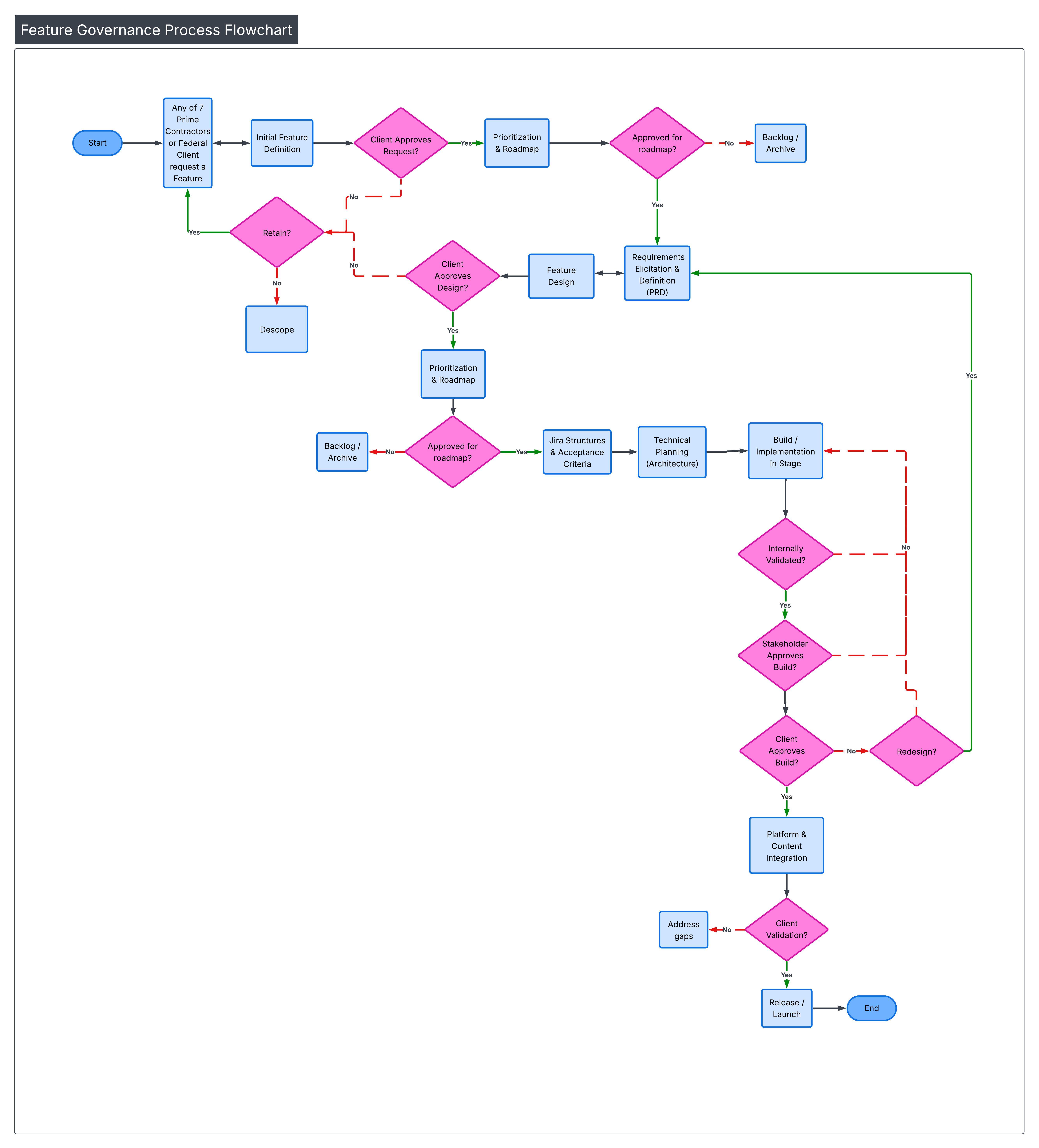
I focused on establishing a shared system for how features move from idea to delivery:
- Conducted stakeholder interviews to map existing workflows, identify inconsistencies, and surface failure points
- Designed a Feature Lifecycle Management framework defining stages from proposal → validation → development → release
- Established governance checkpoints to clarify ownership, decision-making, and readiness at each stage
- Defined metadata structures and tagging conventions to support visibility, filtering, and reporting
- Implemented supporting workflows and documentation to ensure consistent tracking and traceability
- Facilitated alignment across contractors and clients, building shared understanding and buy-in for the model
This approach emphasized clarity, traceability, and shared ownership in a distributed, high-complexity environment.
Results
- Stabilized feature intake, prioritization, and delivery across a multi-contract platform
- Improved clarity of scope, ownership, and dependencies from request through release
- Reduced duplication of effort and misalignment across teams
- Enabled more effective roadmap and program interval (PI) planning
- Established traceability of decisions and feature evolution in a high-compliance environment
Key Takeaway
At scale, feature delivery is not just a development problem—it is a governance problem. Establishing a shared system for intake, decision-making, and lifecycle management enables consistent, coordinated delivery across teams and organizations.

