Context
Adult learning platforms require instructional systems that can respond to highly variable learner needs. Traditional content structures—organized as fixed lessons or linear pathways—limit the ability to provide targeted support at the moment it is needed.
Following development of a comprehensive standards crosswalk aligned to GED and Common Core State Standards frameworks, I explored how instruction could be driven directly by formative assessment signals and structured learning progressions.
Role & Scope
I independently designed a conceptual model for a just-in-time (JIT) instructional system, including:
- a logical data model linking skills, content, and learner state
- structured relationships between standards, content units, and dependencies
- representation of assessment signals used to guide instructional decisions
This work was developed as a proposal informed by real content development and curriculum design constraints.
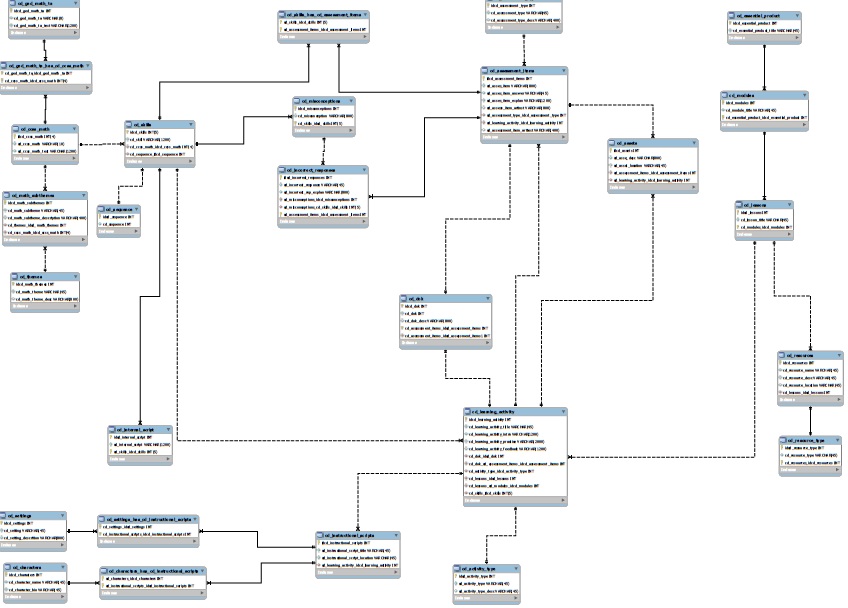
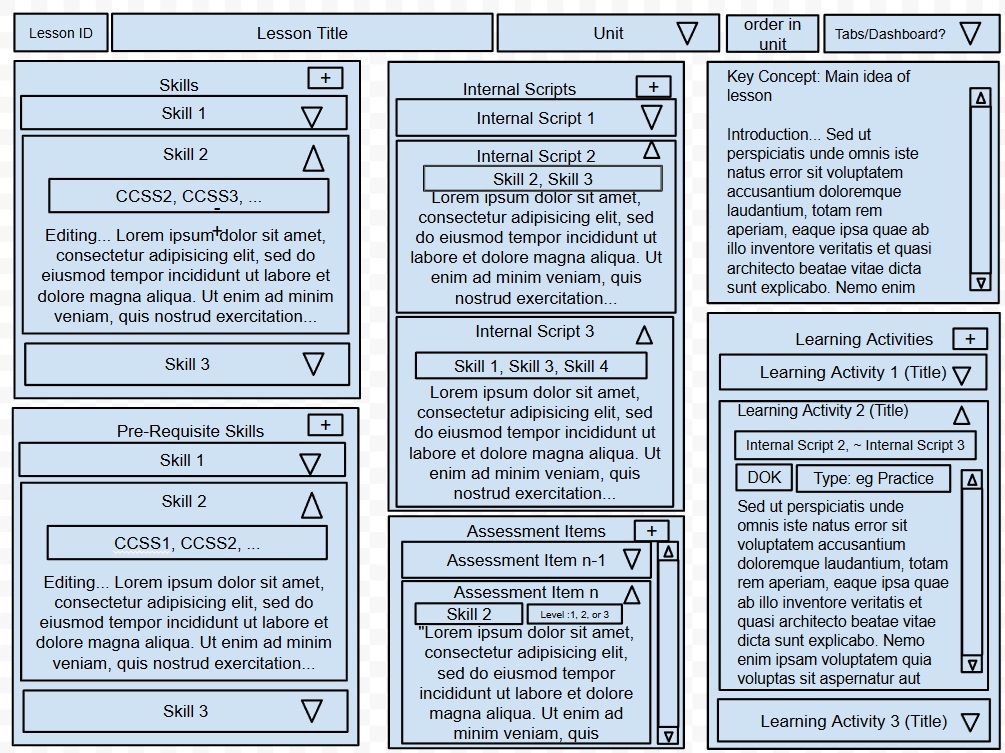
This prototype explored how instructional content can be authored within a structured system, translating the relationships defined in the data model into a usable workflow for content creation and alignment. With content explicitly tied to skills, learning outcomes, and learner-centered representations (“internal scripts”), instruction can be adaptively delivered to reinforce learning or advance progression based on formative assessment data.
Approach
- Structured skills and content based on standards alignment and learning progressions
- Modeled learner state as a dynamic representation of skill development
- Integrated formative assessment signals as drivers of instructional pathways
- Designed relationships to support flexible, on-demand content delivery rather than fixed sequences
- Ensured the model could scale across content areas and learner profiles
Results
- Established a coherent framework for linking assessment and instruction
- Demonstrated how learning progressions could be operationalized in a system
- Provided a conceptual foundation for adaptive, just-in-time instructional delivery
- Anticipated system capabilities that are now increasingly feasible with modern AI tools
Key Takeaway
Adaptive learning is fundamentally a data and systems problem—effective solutions require structuring how skills, content, and learner behavior are represented, connected, and acted upon.

